Media Contact

Abdullah Hasan, ahasan@aclu.org

FOR IMMEDIATE RELEASE

DETROIT — The Detroit Free Press reported this morning that Michael Oliver, a 25-year-old Black man from Detroit, was wrongfully arrested because of a false face recognition match last year. This now appears to be the second known case of someone being wrongfully arrested in the United States as a result of face recognition technology. The American Civil Liberties Union last month shared the story of Robert Williams, who was arrested and detained for nearly 30 hours for a crime he did not commit.

Below is comment from Dan Korobkin, ACLU of Michigan legal director:

“We warned Robert Williams would not be the only person to be wrongfully accused of a crime they did not commit because of a flawed technology law enforcement should not be using. Sadly, it appears we were right and there are still likely many more people we will learn about nationwide. The Detroit Police Department and Wayne County Prosecutor should not need a new policy to know not to arrest someone without having conducted a proper investigation. These are bedrock principles of constitutional law.

“Detroit police’s new policy is a fig leaf that provides little to no protection against a dangerous technology subjecting an untold number of people to the disasters that Robert Williams and Michael Oliver have already experienced. Lawmakers must take urgent action to stop law enforcement use of this technology until it can be determined what policy, if any, can effectively prevent this technology's harms. At the same time, police and prosecutors nationwide should review all cases involving the use of this technology and should notify all individuals charged as a result of it. This technology is dangerous when wrong and dangerous when right.”

Since the ACLU filed a complaint against Detroit police on behalf of Robert Williams, the city has not turned over the case files the family has requested for months, committed to not refile charges against Robert Williams, or stop using the technology to ensure what happened to the Williams family does not happen to another family. Detroit Police Chief Craig did, however, admit that the face recognition technology they are using has a 96 percent error rate. The company that supplies the technology, DataWorks Plus, is now subject to a congressional inquiry.

Related Content

News & Commentary
Aug 01, 2019
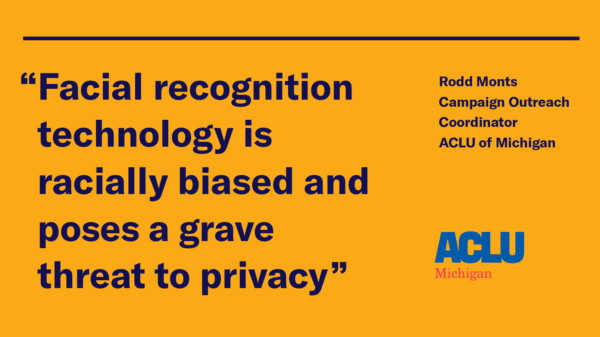
“Facial recognition technology is racially biased and poses a grave threat to privacy”
  • Privacy & Technology|
  • +2 Issues

Facial recognition technology is racially biased and threatens privacy. The Detroit Police Department has no place using it.
Today a diverse coalition of twelve local civil rights organizations urged the Detroit Board of Police Commissioners to reject the Detroit Police Department’s (DPD) proposed use of facial recognition technology in a joint letter.“Facial recognition technology is racially biased and poses a grave threat to privacy,” said Rodd Monts, Campaign Outreach Coordinator for the ACLU of Michigan. “It will disproportionately harm immigrants and communities of color, who already bear the brunt of over-policing. A city like ours should be taking the lead in resisting the use of dangerous and racially biased surveillance technology — not advocating for it.”The coalition’s letter opposes the facial recognition policy proposed by the DPD on July 25. While the DPD claims it will not use its full surveillance capabilities, the coalition opposes DPD’s use of this surveillance technology in any form.  The coalition urges the board to follow the lead of San Francisco, Oakland, and Somerville, Massachusetts, which have also banned police use of facial recognition technology.“The expansion of facial recognition in Detroit supercharges the capability of live Green Light video feeds, creating terrifying real-time surveillance capabilities,” said Eric Williams, senior staff attorney for the Detroit Justice Center’s Economic Equity Practice. “This tool is dangerous mass profiling that has no place in Detroit.”The coalition letter highlights the disproportionate impact the use of facial recognition technology will have on communities of color and immigrants. Recent peer-reviewed studies show this technology inaccurately identifies people of color and women. In a majority Black city, facial recognition technology would lead to false identifications and heighten racially discriminatory policing in Detroit. Immigrant communities are also particularly at risk in response to federal agencies, including U.S. Immigration and Customs Enforcement (ICE) and Customs and Border Patrol, which have used facial recognition tools for enforcement actions.“The proposed facial recognition policy would break the trust between immigrant communities and the Detroit Police Department,” said Dawud Walid, executive director of the Michigan chapter of the Council on American-Islamic Relations (CAIR-MI). “Rather than investing millions of dollars in facial recognition technology that instills fear and targets our communities, we should be investing in the services and resources they need to prosper.”The letter also documents the disturbing threat to privacy posed by DPD’s use of facial recognition technology. The software the DPD purchased is capable of running real-time facial recognition scans on hundreds of live Green Light video feeds, which means the police could keep track of who comes and goes from medical clinics, churches, schools, hotels, political rallies, AA meetings, and countless other sensitive locations throughout the city.  And to use its facial recognition technology, the DPD has access to the Michigan State Police’s (MSP) vast database known as the Statewide Network of Agency Photos (SNAP). SNAP began in 1998 and contains mugshots, more than 40 million driver’s license and ID photos from the Michigan Department of State, and even photos the MSP culled from Facebook and other social media sites. Last year alone SNAP expanded by 2.7 million photos.“Every Michigander is at risk of losing their rights to privacy and due process,” said Tawana Petty, data justice director for the Detroit Community Technology Project. “By having your photo taken for a state ID, you are opening the door to being included in a Michigan State Police database that is now being used for facial recognition—a database that the Detroit Police Department has also leveraged for its use. This is not what anyone signed up for.”The coalition includes: the Arab American Civil Rights League (ACRL), Arab Community Center for Economic and Social Services (ACCESS), ACLU of Michigan, CAIR Michigan, Color Of Change, Detroit Community Technology Project, Detroit Hispanic Development Center, Detroit Justice Center, Michigan Immigrant Rights Center, Michigan United, Metropolitan Organizing Strategy Enabling Strength (MOSES), and We The People – Michigan.
Press Release
Aug 01, 2019
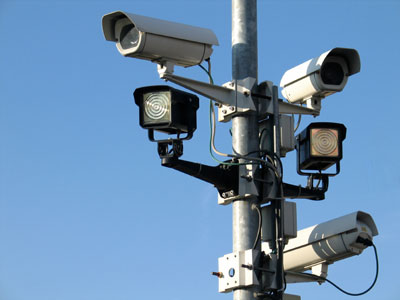
surveillance-cameras-400_0.jpg

Civil Rights Coalition Opposes Facial Recognition Technology in Letter to Detroit Board of Police Commissioners