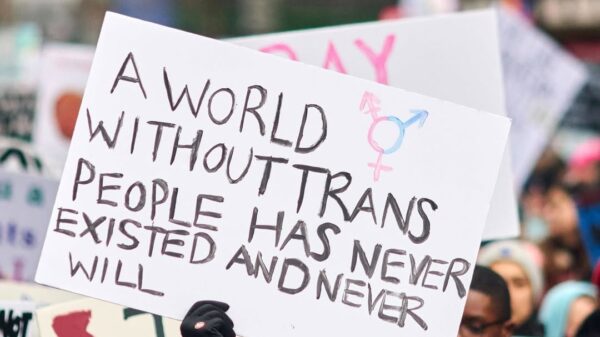


Opponents of LGBTQ+ rights began shifting their focus away from marriage equality after the U.S. Supreme Court’s 2015 landmark decision in Obergefell v. Hodges opened the way to same-sex marriages throughout the country. As The New York Times subsequently reported, that victory for equality prompted the religious right to start shining a malevolent light directly at trans people. Making that turn of events even more disconcerting is the fact that trans youth were often the ones absorbing the brunt of these attacks.
It was a simple calculation.
Reasoning that most Americans are unfamiliar with the concepts of gender dysphoria and gender identity, they believed they could create their own fictitious narrative regarding transgender people, particularly transgender youth, and how this community supposedly threatened the general population.
Unfortunately, many people believed the lies and distortions, allowing far too many politicians to use bigotry and ignorance to rile up their base and generate campaign contributions.
The results have been devastating. Since 2020, we have seen an exponential increase in the number of anti-trans bills being considered by state legislatures, with 850 to 950 pieces of legislation introduced in 2025 alone. Sadly, 27 states now have laws or policies that ban gender-affirming care for transgender youth. The same number of states have bans on transgender girls being able to play interscholastic sports on female teams. Last month, the U.S. Supreme Court heard arguments in two cases challenging the constitutionality of such bans in Idaho and West Virginia. Most court watchers believe the conservative majority will uphold these sports bans.
I hope those predictions are wrong, because the effects of these bans can be devastating for the people they target: kids who are already dealing with the immense difficulties that come with being a trans youth.