
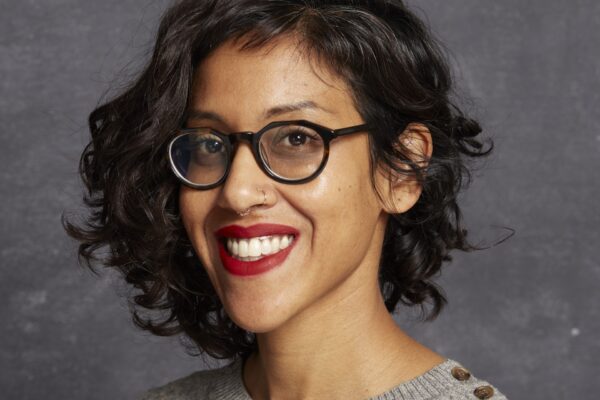
The daughter of immigrants from Bangladesh, Rhea Rahman came to Michigan from her native Alabama at the start of elementary school. Spending much of her youth in a predominantly white community, and wanting to look like the people around her, it wasn’t until she began attending the University of Michigan as an undergrad that she started meeting large numbers of others students with roots in South Asia, leading her to embrace her heritage. that she learned to embrace her culture. Now an assistant professor of anthropology at Brooklyn College, she has just written a book titled “Racializing the Ummah: Muslim Humanitarians beyond Black, Brown, and White”, which deals with the extensive reach of white supremacy in the Islamic world. As part of our Asian American/Pacific Islander Month celebration, we sat down to talk with Rhea about her youth, her work, what the term “racial capitalism” means, and what podcasts she’s checking out these days.
What were things like for you early on in life?
My parents emigrated from Bangladesh, and I was born in Alabama. We moved to Michigan when I was 5 because my father, who is a mechanical engineer, got a job here. After landing for a while in Sterling Heights, we moved to Macomb Township when I was in the 4th grade. That transition was hard.
In what way?
Though Sterling Heights was a bit more diverse, Macomb Township at the time felt very white. I felt terribly out of place. I think my reaction was fairly typical for a person of color, the kid of non-white immigrants, in a situation like that: I wanted to be like everyone else, I didn’t want to be “different.” I wanted to be white, so that I could fit in.
That is what racism and white supremacy does to a young Brown or Black person. I internalized this feeling of inferiority, then tried to overcome that feeling by striving to be a high achiever. Again, that is common to the immigrant experience: feeling the pressure to excel, knowing that you must work twice as hard for half as much, all under a much higher level of scrutiny.
It wasn’t until I was in college, when I met other kids with roots in South Asia who weren’t embarrassed about their heritage, that I could begin to embrace my heritage, and be proud of where my family comes from.
What did you study in college?
I went to the University of Michigan, where my major was social anthropology.
Why that field of study?
I really didn’t even know what anthropology was until I began attending college. But after my first class, I knew it was something I wanted to pursue. Anthropology is a subject that, as I understood it, is about understanding, and making space for, human differences. You learn to embrace difference. I liked that it's a field of study that would allow me to go to new places and understand different cultures and different ways of living. I remember growing up in white suburbs felt suffocating to me. From a young age, I knew I wanted to get out and explore the world and I felt studying Anthropology would allow me to do that.
Were you able to do that?
Yes. After I graduated I spent a year working at a non-governmental organization (NGO) in Bangladesh that focused on development.
What was that experience like?
I came away disillusioned. As a child of immigrants, growing up in a “rich” country with relatives from a “poor” country, I straddled two worlds that are divided by extreme material inequality. I wanted to do good in the world and change that. But, from what I was able to see firsthand in Bangladesh, “development” does not solve the problems of global inequality, because the problems run much deeper than an NGO can address. It is like putting a Band-Aid on a broken leg.
You went on from there to obtain master’s degrees from the University of Chicago and the New School for Social Research, where you also obtained your Ph.D. Now an assistant professor at Brooklyn College, you’ve just published your first book. Tell us about that.
The book is titled Racializing the Ummah: Muslim Humanitarians Beyond Black, Brown and White. The focus is on Islamic Relief (IR), the largest Islamic NGO based in the West. In the book, I examine the organization's projects, methods, and limitations to show the impacts of Islamophobia, how racial capitalism permeates all aspects of humanitarianism.
What do you mean by racial capitalism?
The concept of racial capitalism is widely discussed and debated in the various fields of study that I'm involved and engage in. For me, I understand it as, capitalism as a system is based on exploitation and as such, it requires extreme human inequality. Race – a product of racism born out of slavery and colonialism – creates the categories and justifications for those inequalities. Of course, race intersects in significant ways with other categories such as gender and class, so these categories also always have to be considered together.
What is it you hope people will take away from your book?
One thing I hope is that people will have a better understanding of white supremacy and its effects. A lot of people think of white supremacy as white nationalist groups like the KKK. But I often quote the poet Guante, who said, white supremacy is not a shark, it's the water. In the book, I describe white supremacy as the water, because of the way it has been normalized and organized into a hierarchal structure.
For example, it was only through the process of study involved in writing this book, that I learned about the significance and contributions of Black Muslims to global Islamic traditions. I barely knew Black Muslims existed, much less that I grew up just a few miles outside of Detroit, where the Nation of Islam was founded! I realized that my own racially segregated Muslim experience growing up in the suburbs of Detroit, was also a product of white supremacy.
So, I also hope people will develop a more nuanced perspective on human differences, and understand that Muslims are not a monolith. We are also not immune from both the effects of, and complicity with, white supremacy. But I also try to showcase the potential for resistance found in the Black radical tradition and Islam.
Shifting gears a bit, are there any movies depicting the lives of Asian Americans that you would recommend people check out?
Yes! “Mississippi Masala,” a 1991 film from Indian director Mira Nair, (the mother of NYC major Zohran Mamdani!) does a great job looking at the nuance of racial logics as they play out across different cultures. The film centers on a romantic relationship between a young woman of Indian heritage whose family has moved from Uganda to the American South, where she falls in love with a Black man played by Denzel Washington. The film explores the complicated racial tensions of anti-Blackness among non-Black Asian communities in the U.S., as well as white supremacist colonial logics that shape post-independence Uganda It does a great job of depicting the scope of racialization that occurs across cultures, which is a topic my book explores.
Are there any podcasts that you’d recommend?
Yes. I’ve been a long-time listener and supporter of “The Red Nation Podcast.” It features discussions on Indigenous history, politics, and culture from a left perspective. Other favorites include “The East is a Podcast,” “Millennials Are Killing Capitalism,” “Guerilla History,” and “Electronic Intifada.” They all examine issues and events from an anti-capitalist, and-imperialist perspective. They help me better understand the war we started against Iran and other issues by cutting through the propaganda that exists in mainstream media.
What advice do you have to offer people during these tumultuous times?
In this historical moment, with the U.S. in a war, with fascism already here, both here and abroad, it is we the people who will keep us safe. For example, as the brave and organized people of Minnesota showed us in response to the federal invasion of their city in January of this year, we have to show up for and protect each other, especially when we realize that it's the institutions that we are led to believe are there to serve us, are the ones doing the harm. To survive this historical moment, we all have to work together.