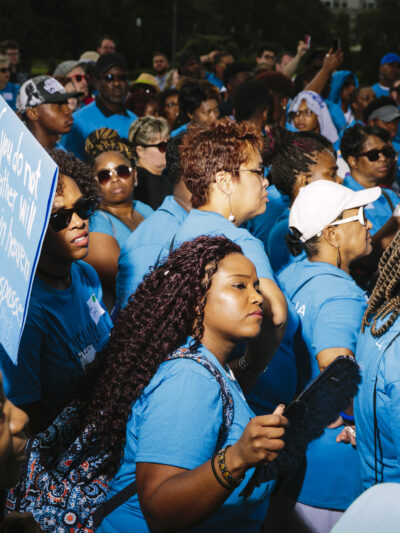
Facial recognition technology is racially biased and threatens privacy. The Detroit Police Department has no place using it.

Today a diverse coalition of twelve local civil rights organizations urged the Detroit Board of Police Commissioners to reject the Detroit Police Department’s (DPD) proposed use of facial recognition technology in a joint letter.“Facial recognition technology is racially biased and poses a grave threat to privacy,” said Rodd Monts, Campaign Outreach Coordinator for the ACLU of Michigan. “It will disproportionately harm immigrants and communities of color, who already bear the brunt of over-policing. A city like ours should be taking the lead in resisting the use of dangerous and racially biased surveillance technology — not advocating for it.”The coalition’s letter opposes the facial recognition policy proposed by the DPD on July 25. While the DPD claims it will not use its full surveillance capabilities, the coalition opposes DPD’s use of this surveillance technology in any form.  The coalition urges the board to follow the lead of San Francisco, Oakland, and Somerville, Massachusetts, which have also banned police use of facial recognition technology.“The expansion of facial recognition in Detroit supercharges the capability of live Green Light video feeds, creating terrifying real-time surveillance capabilities,” said Eric Williams, senior staff attorney for the Detroit Justice Center’s Economic Equity Practice. “This tool is dangerous mass profiling that has no place in Detroit.”The coalition letter highlights the disproportionate impact the use of facial recognition technology will have on communities of color and immigrants. Recent peer-reviewed studies show this technology inaccurately identifies people of color and women. In a majority Black city, facial recognition technology would lead to false identifications and heighten racially discriminatory policing in Detroit. Immigrant communities are also particularly at risk in response to federal agencies, including U.S. Immigration and Customs Enforcement (ICE) and Customs and Border Patrol, which have used facial recognition tools for enforcement actions.“The proposed facial recognition policy would break the trust between immigrant communities and the Detroit Police Department,” said Dawud Walid, executive director of the Michigan chapter of the Council on American-Islamic Relations (CAIR-MI). “Rather than investing millions of dollars in facial recognition technology that instills fear and targets our communities, we should be investing in the services and resources they need to prosper.”The letter also documents the disturbing threat to privacy posed by DPD’s use of facial recognition technology. The software the DPD purchased is capable of running real-time facial recognition scans on hundreds of live Green Light video feeds, which means the police could keep track of who comes and goes from medical clinics, churches, schools, hotels, political rallies, AA meetings, and countless other sensitive locations throughout the city.  And to use its facial recognition technology, the DPD has access to the Michigan State Police’s (MSP) vast database known as the Statewide Network of Agency Photos (SNAP). SNAP began in 1998 and contains mugshots, more than 40 million driver’s license and ID photos from the Michigan Department of State, and even photos the MSP culled from Facebook and other social media sites. Last year alone SNAP expanded by 2.7 million photos.“Every Michigander is at risk of losing their rights to privacy and due process,” said Tawana Petty, data justice director for the Detroit Community Technology Project. “By having your photo taken for a state ID, you are opening the door to being included in a Michigan State Police database that is now being used for facial recognition—a database that the Detroit Police Department has also leveraged for its use. This is not what anyone signed up for.”The coalition includes: the Arab American Civil Rights League (ACRL), Arab Community Center for Economic and Social Services (ACCESS), ACLU of Michigan, CAIR Michigan, Color Of Change, Detroit Community Technology Project, Detroit Hispanic Development Center, Detroit Justice Center, Michigan Immigrant Rights Center, Michigan United, Metropolitan Organizing Strategy Enabling Strength (MOSES), and We The People – Michigan.

“Facial recognition technology is racially biased and poses a grave threat to privacy”

Sharee Miller was fired for reporting severe abuse of fellow inmates. Under this new settlement, prisoners can report without retaliation.

The ACLU of Michigan has settled a federal lawsuit after the Michigan Department of Corrections agreed to a major policy change that will allow prisoners to report any abuse they witness of other inmates.

"There's no excuse for abuse or neglect of prisoners."

Detroit's poorest residents are being denied access to water. We've filed a petition to avoid a health emergency.

Residents at more than 112,000 Detroit households had their water disconnected between 2014 and October 2018, simply because they couldn’t afford to pay.

“The public health crisis DWSD creates by shutting off water service for thousands of people is completely avoidable,” said Mark P. Fancher, staff attorney for the ACLU of Michigan’s Racial Justice Project.

Aimee Stephens fights for us. Now let’s fight for her.

It was a do or die moment. Literally.

By Curt Guyette

Aimee Stephens

ACLU urges State Supreme Court to reject the legislature’s attempt to undermine voters

The ACLU of Michigan filed a brief today urging the Michigan Supreme Court to reject the legislature’s attempt to undermine the will of the voters by removing citizen-led proposals from the ballot through an anti-democratic maneuver known as “adopt and amend.”

By Sharon Dolente

ACLU Generic Web Graphics-01.png

How the 1994 Crime Bill Fed the Mass Incarceration Crisis

The 1994 federal crime bill that created tough new criminal sentences and incentivized states to build more prisons and pass truth-in-sentencing laws is getting new scrutiny during this 2020 election cycle. Defenders of the law deny that it created the problem of mass incarceration, a term used to describe the fact that the United States incarcerates more of its people — disproportionately Black — than any other nation in the world. They argue that mass incarceration was a problem before the law passed. And regardless, they argue, the federal government has limited jurisdiction over the problem, as 90 percent of people in prison and jail are under state jurisdiction. So who’s right? It’s true that the federal government has limited jurisdiction over mass incarceration and that incarceration rates were already high by 1994. But it’s also true that following passage of the federal crime bill, incarceration rates continued to climb for an additional 14 years. The federal crime bill did not trigger mass incarceration, but it certainly encouraged mass incarceration to grow even further. The 1994 law was the largest crime bill in the history of the United States. It was meant to make a statement, and it did — in at least two ways. First, the 1994 crime bill gave the federal stamp of approval for states to pass even more tough-on-crime laws. By 1994, all states had passed at least one mandatory minimum law, but the 1994 crime bill encouraged even more punitive laws and harsher practices on the ground, including by prosecutors and police, to lock up more people and for longer periods of time. Second, the 1994 law shaped Democratic Party politics for years to come. Under the leadership of Bill Clinton, Democrats wanted to wrest control of crime issues from Republicans, so the two parties began a bidding war to increase penalties for crime, trying to outdo one another. The 1994 crime bill was a key part of the Democratic strategy to show that it can be tougher-on-crime than Republicans.While Republicans continued their Willie Horton-style fear-mongering that pushed for more punitive policies in the states, the official 1996 Democratic Party platform, which was meant to provide a vision for the Democratic Party nationwide, relied heavily on the 1994 law to display their tough on crime credentials. An entire section in the platform is dedicated to "tough punishment," taking pride in the fact that the Democratic Party passed tougher sentencing laws and provided more federal funding for prisons in the states.The platform encouraged states to pass truth-in-sentencing laws, bragged about instituting the death penalty for nearly 60 more crimes, and even encouraged the prosecution of young people as adults. This platform remained largely in place until 12 years later, when in 2008, the tone and substance began to change under new leadership in the party. Coincidentally, incarceration rates peaked in 2008. The right way to view the 1994 crime bill is as the moment when both parties, at a national level, fully embraced the policies and political posturing that exacerbated the mass incarceration crisis we are trying to fix today. In 2019 and beyond, the best course of action for politicians who want to promote a smart justice-oriented vision for America is to disavow the 1994 crime bill and instead support a 50% cut in incarceration rates on the federal and state levels. Those running for federal office should pledge to use their power to close prisons once in office. That would be the best way to counteract the effects of the 1994 crime bill and prove that you don’t believe in the discredited tough-on-crime policies of the past.

President Bill Clinton signs the $30 billion crime bill during a ceremony on the South Lawn of the White House in Washington on Sept. 13, 1994

Smart Justice and Mental Health Awareness Month

This Mental Health Awareness Month let’s talk about how mental illness plays into mass incarceration.

Mental Health Awareness Month Graphic

National Day of Action for Reproductive Freedom

You’ve seen the news. Missouri has joined Georgia, Ohio and Alabama in passing extreme bans that criminalize doctors and make abortion a felony.  

National Day of Action Reproductive Freedom

Jackie Washington, First African American ACLU of Michigan President, Brought Credibility and Passion to Civil Rights Work

Jacquelin Washington forged equal opportunity and leadership roles for women, especially for African American women, when it felt like there were none. She shattered glass ceilings and shaped executive roles into positions held by women, and expanded the work of the American Civil Liberties Union (ACLU) and others to fight for the rights of all minorities. For the decades leading to her 1995 induction into the Michigan Women’s Hall of Fame, Jackie was a trailblazer.

Black and white head shot of Jackie Washington