
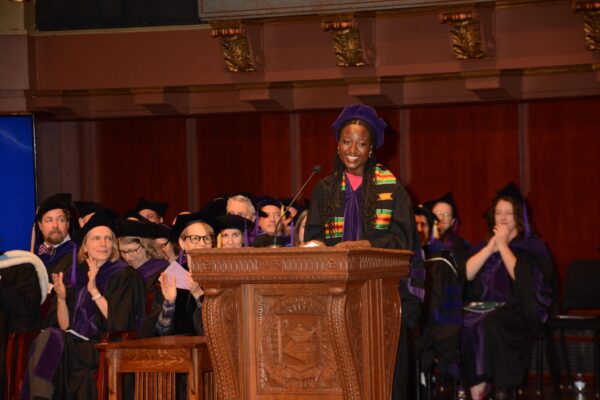
As the daughter of people who came to the United States from Ghana, Ewurama Appiagyei-Dankah’s worldview has been shaped in part by both the immigrant experience of her parents, and the fact that she is a Black woman navigating life in 21st century America. As part of our Black History Month celebration, we sat down with our West Michigan Legal Fellow for a wide-ranging Q&A that delved into her experiences as a youngster, which involved frequent moves, and some of the challenges she faced while attending a predominantly white high school. We also asked about what attracted her to the law when she chose a career, and what it is like representing Iraqi immigrants threatened with deportation. We also talked with her about meeting civil rights icon John Lewis, why R&B singer Ari Lennox is at the top of her playlist these days, and what has her feeling optimistic in these turbulent times.
What was life like for you as a kid?
Although I was born in the United States, and have always been a citizen because of that, my life has been shaped by the immigrant experience. My parents came here from Ghana so that my father could pursue higher education. He’s now a pediatric endocrinologist who treats children with diabetes and other pancreatic issues.
Because he was in various stages of his medical training when I was young, I had the experience of moving several times. I was born in Mineola, New York , where my dad did his residency and we lived there until I was 5. We then moved to Charleston, South Carolina where he practiced medicine and taught medical students. The next stop was Cascade, Michigan, where we came just as I was entering high school.
Moving at that age can be a challenge for anyone. But you were in a situation where you are a young Black person with immigrant parents moving from a relatively large city and a diverse environment to smaller town that is overwhelmingly white. That could not have been easy.
It was challenging, for sure. And there were a lot of things I had to face. One of them was, because there were so few Black people at my school, I felt a lot of pressure to be perfect. I’ve always been highly motivated, but this was different. I felt that I couldn’t slip up in any way because I felt like I represented more than myself. That created a lot of added pressure.
What kind of toll does that sort of pressure take?
It’s not something that I would wish on anyone. And it’s certainly a lot to deal with as a kid—it's too much pressure for any kid. I felt like I always had the “you have to be twice as good” mantra in my head. I’ve worked very hard now that I’m older to remind myself that I am worthy just by virtue of being a person in the world, and that I don’t have to prove myself to anyone.
How did you deal with it?
I just threw myself into my schoolwork and extracurricular activities. I was on the track and field team. I performed in musicals put on by the school. I sang in the Grand Rapids Symphony Youth Chorus. And I was on the student council all throughout high school.
When did you become interested in the law?
I always knew that I would pursue a career related to public service. I think that comes, in large part, from being the child of immigrants. My family has benefited so much from being in this country, I wanted to have a career that allowed me to give back, and to help ensure others have the same opportunity to thrive here.
With that goal in mind, I attended Michigan State University’s James Madison College, which focuses on public affairs education through interdisciplinary programs. It was while taking a class called Law and Social Groups that required reading and analyzing U.S. Supreme Court decisions that it fully dawned on me how much the law shapes all of our lives. It determines who is or is not a citizen, who has what rights, what a person’s quality of life might be. Racial equality. Gender equality. Immigrant rights. There were all these things I was interested in. And I realized that the law provided a pathway to address all that and much more.
Was there anything else that shaped your undergrad experience?
There was a lot, but two things stand out.
One of the most significant experiences was being in school when Michigan State was navigating the Larry Nassar sexual abuse case. I was our student government’s vice president, and deeply involved in the issue because of that. We saw first-hand the institutional failures that allowed the abuse to continue for so long, and the way leadership tried to close ranks and shield themselves. It was horrible to see. The response from me and other student leaders was to support the survivors within our student body and broader community, fight for accountability from our school, and to try and make the university less insular. I think that, to some degree, we succeeded in doing that. What I learned from that experience is that you need to do the right thing, even if it scares you.
Another very important experience I had was getting to meet John Lewis. I knew before we met what an incredible figure in American history he was -- a pivotal leader of the Civil Rights Movement, including leading the march on Selma, who went on to become a congressman. I got to say thank you to him, for everything he and others had done enduring horrible brutality so that Black people could become more equal members of society. So, it was really an honor to meet him. And part of what made it so great is who he was as a person. He was just so kind to every single person, so warm.
Your drive to be a high achiever, and your commitment to social justice, resulted in your fellow classmates voting to have you represent them by speaking at your Michigan Law School graduation. What was that experience like?
It was one of the biggest honors of my entire life. Law school is a bear—at least, it was for me! It is challenging, it pushes you to the edge of your comfort zone, and it forces you to grow. It’s not just that you’re learning about the law—you’re learning about what you are capable of, too. I described it in my speech as “brutal, glorious, and transformative.” And having my classmates choose me to talk about what that experience was like for us—how we navigated it while trying to be siblings, partners, friends, and just people in the world—it meant, and means, more to me than I can put in words.
After serving as an intern while in law school, you returned to the ACLU of Michigan after graduation to be the organization’s West Michigan Legal Fellow. What have you been working on?
Much of my focus has been on working with members of our class action lawsuit, Hamama v. Adducci, which we filed on behalf of Iraqi immigrants threatened with deportation to their homeland, where they faced the risk of persecution, torture or death. Our lawsuit was able to ensure that this group of people – which numbered more than 1,400 individuals, many of whom are Chaldean Christians – would have their due process rights protected by ensuring none of them could be indefinitely detained.
As a result of the litigation and settlement, class members have had time to reopen their immigration cases, have their individual cases reviewed by an Immigration Court Judge, and pursue lawful status or citizenship based on current conditions in Iraq. With that as the big picture, I’ve been busy assisting individual class members as they fight to stay in this country and, for many of them, as they seek release from immigration detention. The feeling is so amazing every time someone is released because of the settlement’s protections. Because it is not just about that one person’s life being made better; it is also about all the other lives affected by that one person’s fate – family members and other loved ones -- so the positive results are compounded many times over.
The downside is that there are times when someone doesn’t win relief, and they end up being deported. It is just gut wrenching when that happens, and it weighs heavily on me, honestly. But, even though it can be tough in a lot of ways, doing this kind of important work at this time in history, helping people, and to be surrounded by so many colleagues who are so dedicated to protecting civil rights and liberties for all Michiganders – I feel incredibly lucky. Truly.
With stakes so high, it is pressure-packed work you are doing. How do you relieve stress?
I love to run and bake! I also love talking on the phone with my best friends and family. They keep me grounded and help pick me up on the tough days. I also love going for walks with my fiancé, especially at a beautiful nature preserve in Grand Rapids called the Blandford Nature Center.
This being Black History Month, are there any movies depicting the Black experience you’d like to recommend?
One movie I’d definitely recommend is “Fruitvale Station,” which stars Michael B. Jordan, and is based on the true story of a young Black man killed by transit police in Oakland, Ca. It is such a tragic story – one that is replicated over and over again across the United States – I sobbed the whole way through it.
At the other end of the spectrum is
‘Black Panther,” which takes place in a fictional African country and features a Black superhero played by Chadwick Boseman. It is just a fun, joyful, and deeply cool movie. I just love Ryan Coogler’s movies in general.
How about books?
Yes! Ok, these are fairly large books about the same period of time: one is called “Black Reconstruction” by W.E.B. Du Bois, and one called “Reconstruction: America’s Unfinished Revolution, 1863-1877” by Eric Foner. Both books are about the Reconstruction era and its immediate aftermath – which is one of my favorite eras of American history to learn about because of the interplay between the federal government and the states, the newly found role Black people were playing in the post-Civil War political process, and how the end of Reconstruction shapes our present day. Eric Foner’s book builds on the book by W.E.B Du Bois.
On a different note, I also adore “Their Eyes Were Watching God” by Zora Neale Hurston.
What music are you listening to these days?
I’m listening to a lot of Ari Lennox, an R&B singer-songwriter with an amazing voice. Her album “Shea Butter Baby” is in my top five albums of all time. Her music really resonates and makes me feel seen. “Shea Butter Baby” and “A Seat at the Table” by Solange both make me feel that way.
I’m also a big fan of Kendrick Lamar. His “Good Kid, M.A.A.D City” album (from 2012) is something I listen to over and over. It is also in my top five albums. The whole album is a look at his life growing up in Compton, and what it was really like for him. He is such a good storyteller. It is a really, really well-executed album that provides a lot of insight into the life of an incredible artist. I love all his work, but this album is my favorite of his!
Finally, what has you feeling optimistic these days?
Seeing the ways people are caring for their immigrant neighbors during these really troubling times. Groceries are being provided to people who are afraid to venture out, things like that. All sorts of mutual aid is being provided by everyday people. As long as we can keep that spirit, and keep caring for each other, that is the most important thing. Seeing that happen the way it is now gives me a lot of hope for the future.